Basics (Must Read)
Sudoku Grid and Coordinates
Grid
A standard Sudoku board is a 9×9 grid with 81 cells.
Coordinates
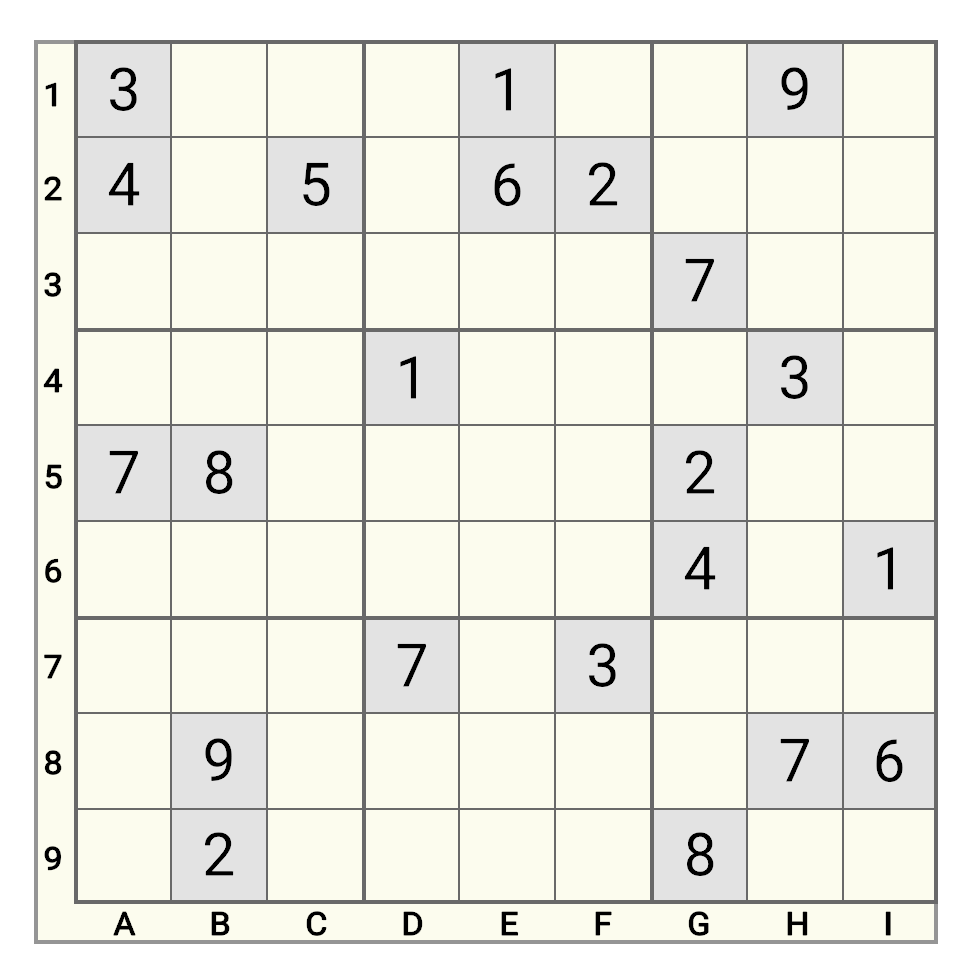
The game uses letters and numbers to represent cell coordinates:
- Columns : A-I from left to right (9 columns)
- Rows : 1-9 from top to bottom (9 rows)
- Cells : Column letter + row number, such as A1 , B3 , I9
rycx Coordinate System
Besides the letter+number format used in our game, the Sudoku community also uses another common coordinate representation:
rycx format : Uses numbers to represent coordinates in the format rycx
- r : row, numbered 1-9 from top to bottom
- c : column, numbered 1-9 from left to right
- Cell : r + row number + c + column number, such as r1c1 , r3c2 , r9c9
Conversion examples :
- A1 = r1c1 (row 1, column 1)
- C7 = r7c3 (row 7, column 3)
- H2 = r2c8 (row 2, column 8)
- E5 = r5c5 (row 5, column 5, center cell)
The rycx format is commonly used in Sudoku literature and most solving software, but our game uses the simpler letter+number format.
Regions
Standard Sudoku has 3 types of regions (27 total):
- Rows : 9 horizontal rows, labeled Row 1 through Row 9
- Columns : 9 vertical columns, labeled Column A through Column I
- Blocks (or Boxes): 9 3×3 squares, labeled Block 1 through Block 9
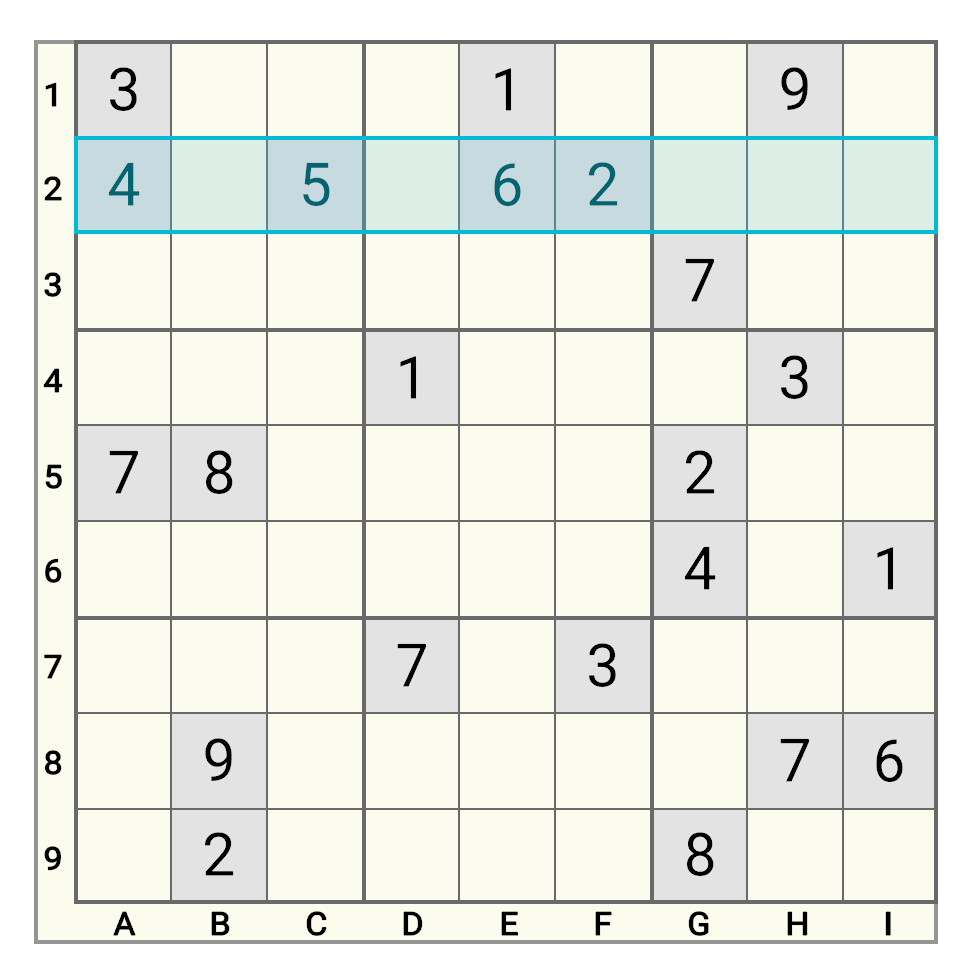
The blue area in the image represents Row 2 .
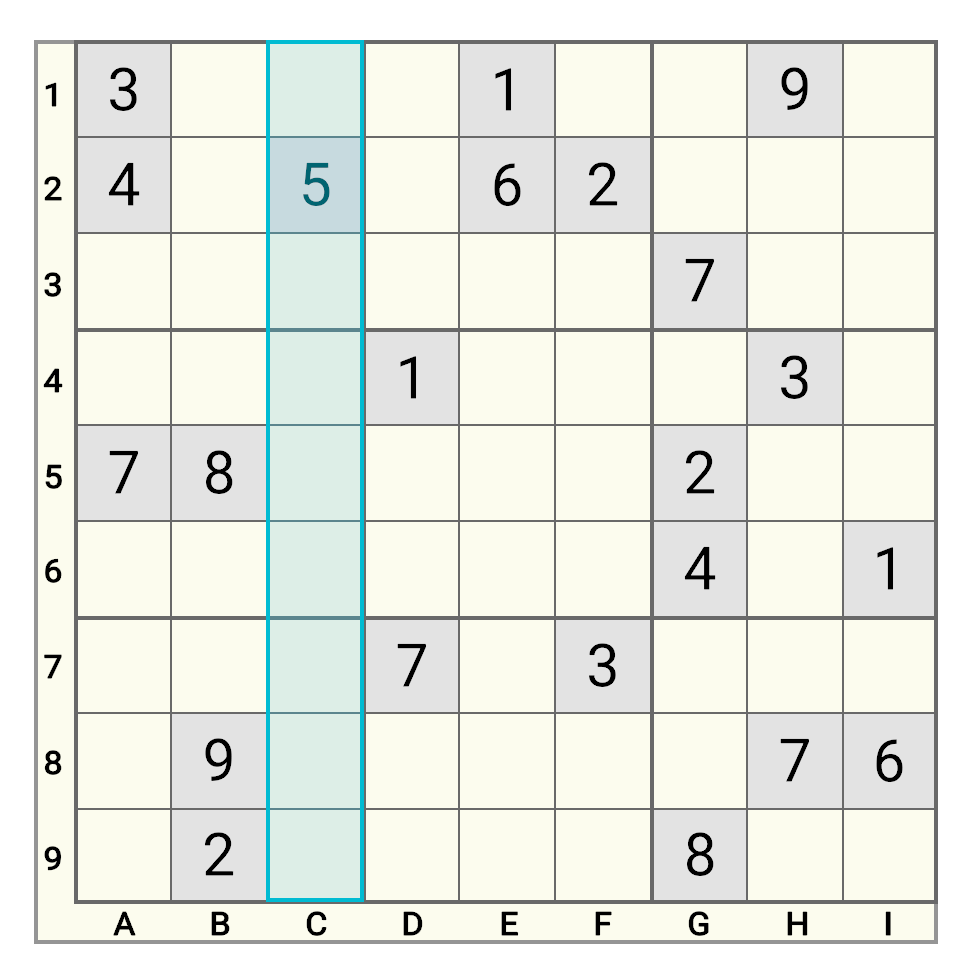
The blue area in the image represents Column C .
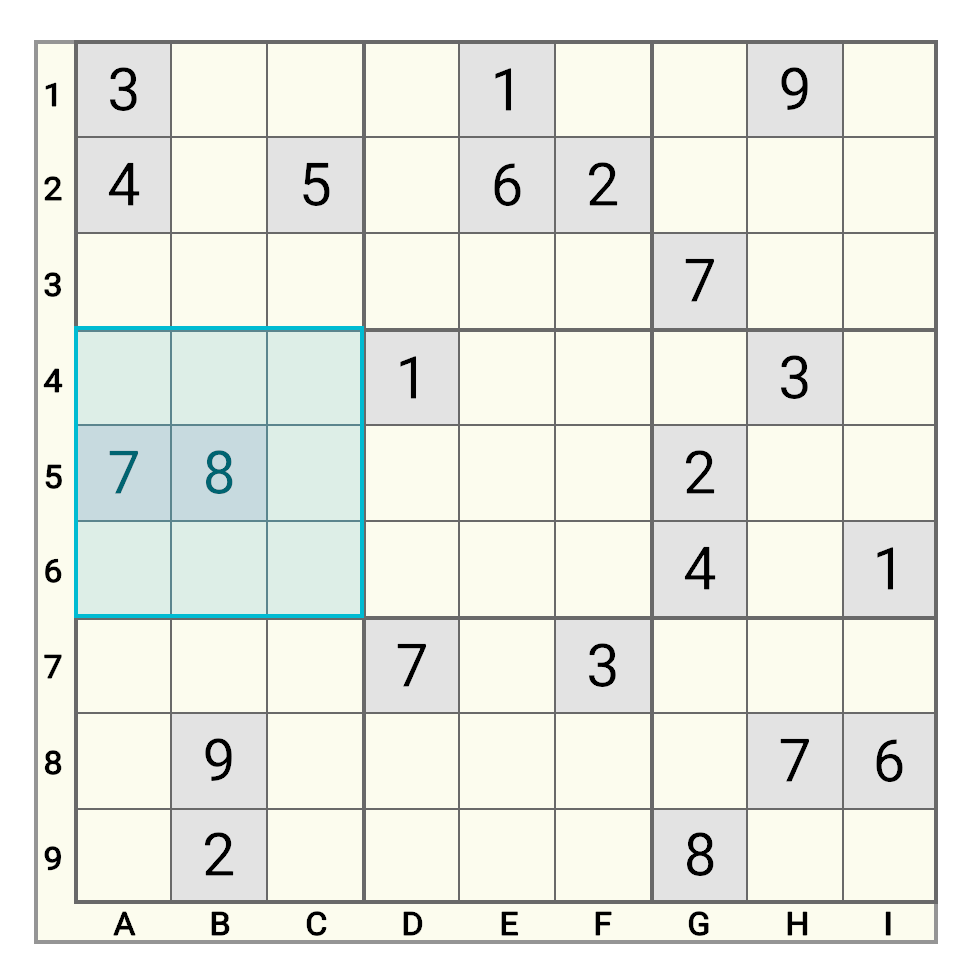
The blue area in the image represents Block 4 .
See
See : Two cells can see each other if there exists a region that contains both cells. Otherwise, they cannot see each other.
In our definition, a cell cannot see itself.
Sudoku Rules
Place a number from 1 to 9 in each empty cell so that each number occurs exactly once in every region.
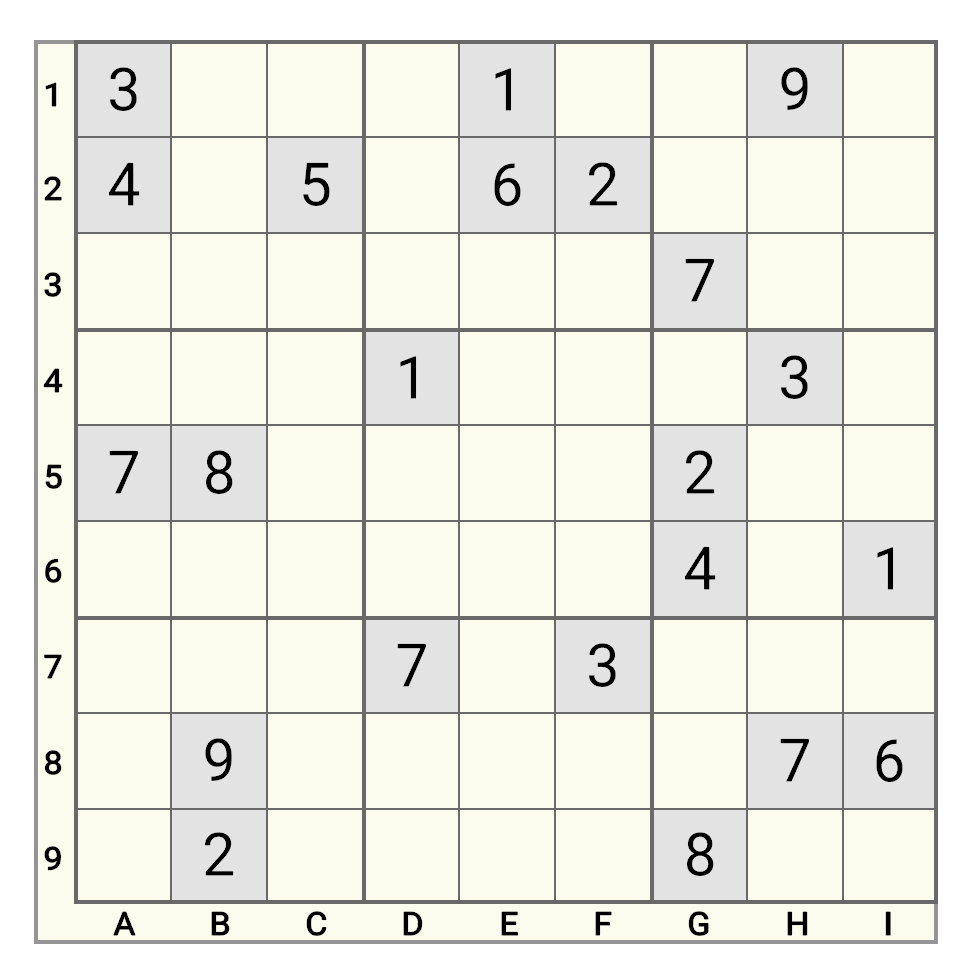
As shown in the image, this is a Sudoku puzzle. The numbers given in the puzzle are called givens , represented with cells with gray backgrounds in the image.
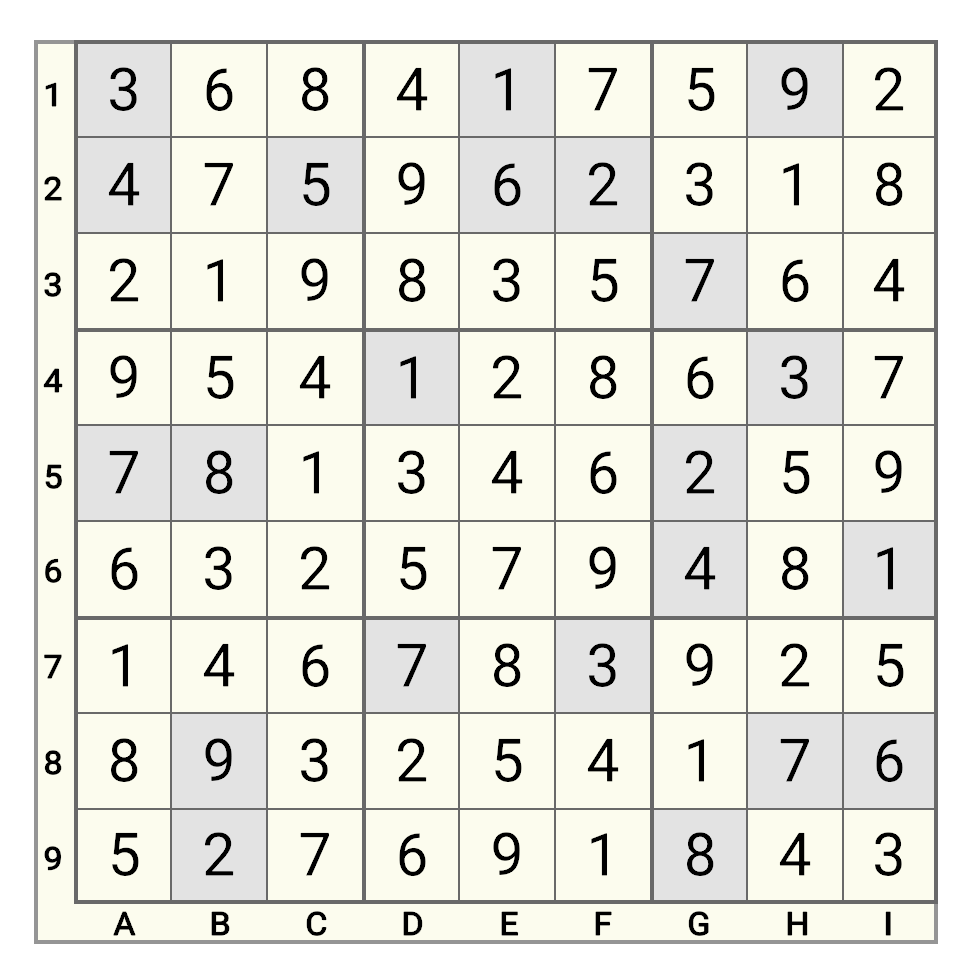
This is the solution to the puzzle. You can see that each number appears exactly once in every region, following the Sudoku rules, making this the solution.
Candidates
Except for very simple Sudoku puzzles, we usually need to use the candidates tool.
What are Candidates?
Candidates are the possible numbers that can be placed in an empty cell. In a cell, after eliminating numbers that already appear in the same row, column, and block, as well as using other logical elimination methods, the remaining possible numbers are called candidates.
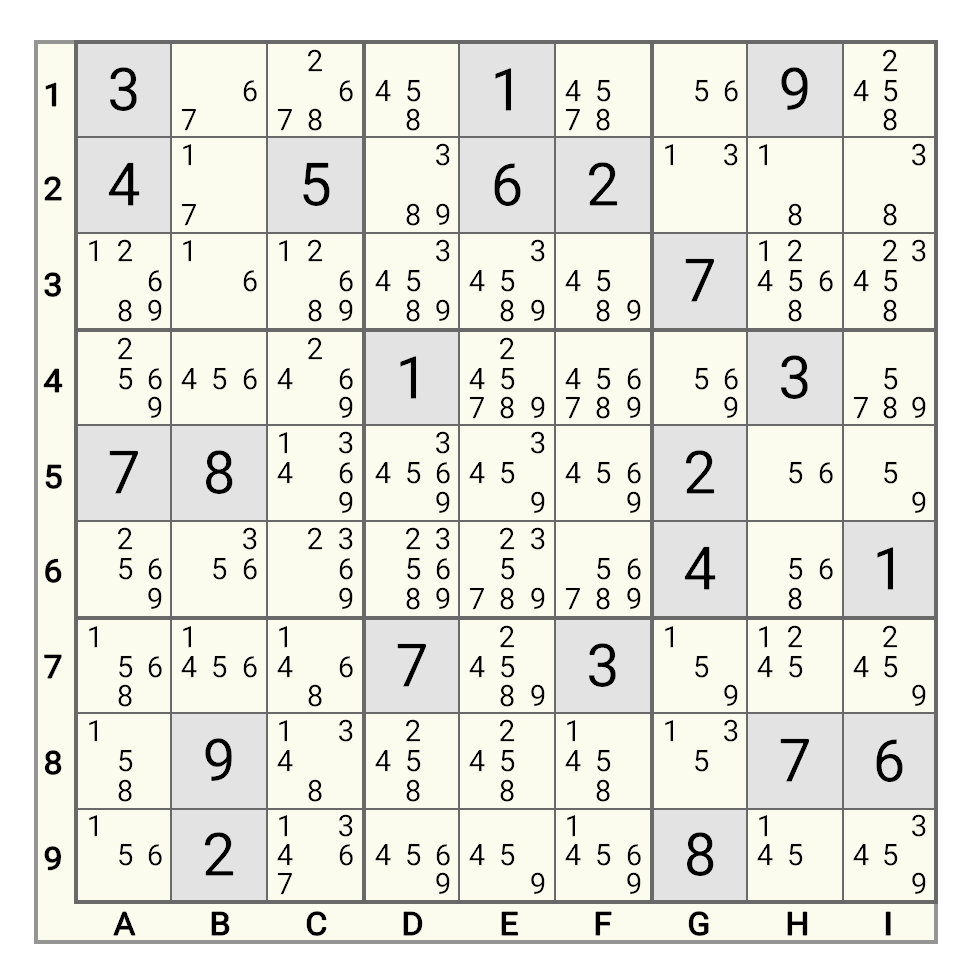
As shown in the image, this is a Sudoku puzzle with its initial candidates (shown as small numbers) - the candidates for each empty cell after eliminating impossible numbers based on the filled numbers.
The game has Auto Candidates enabled by default, automatically calculating candidates for each empty cell when starting a new puzzle. When filling in numbers, it automatically eliminates candidates from related cells, improving solving efficiency.
Basic Theory (Optional)
Definition of “See”
When two cells and , where , and if there exists a such that , we say that can see , and can see , or that and see each other.
In our definition, a cell cannot see itself.