Naked Techniques
This page covers naked techniques in Sudoku, including Naked Single and Naked Set. These techniques are fundamental to Sudoku solving and mastering them is essential for tackling Sudoku puzzles.
Naked Single
A Naked Single : When a cell has only one candidate remaining, the cell must be filled with the number.
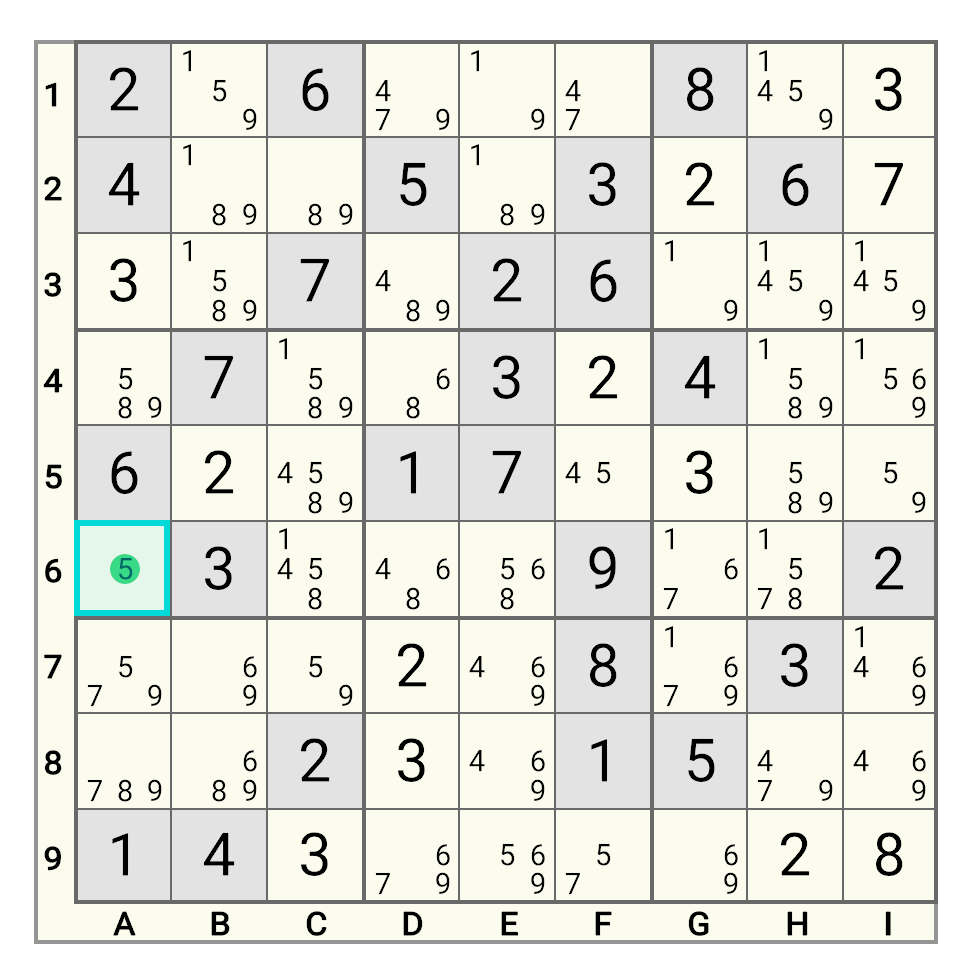
In the image, cell A6 has only candidate 5 remaining, so A6 must be filled with 5 . This is called a Naked Single because cell A6 has only one candidate, making the answer obvious.
How to use :
- Look for cells with only one candidate
- Fill in that candidate directly
Naked Set
A Naked Set (or Naked Subset, also called Locked Set) refers to a group of cells where the number of candidates exactly equals the number of cells, where the number of cells .
Elimination logic : Within the same region, if n cells contain exactly n different candidates, then these n cells must be filled with those n numbers. Therefore, these candidates can be eliminated from all other cells in that region.
A Naked Set can be viewed as a generalization of the Naked Single technique, while Naked Single is the simplest case of Naked Set ().
Naked Pair
A Naked Pair is a Naked Set with . That is, 2 cells contain a total of 2 candidates. Typically, these 2 cells have exactly the same candidates.
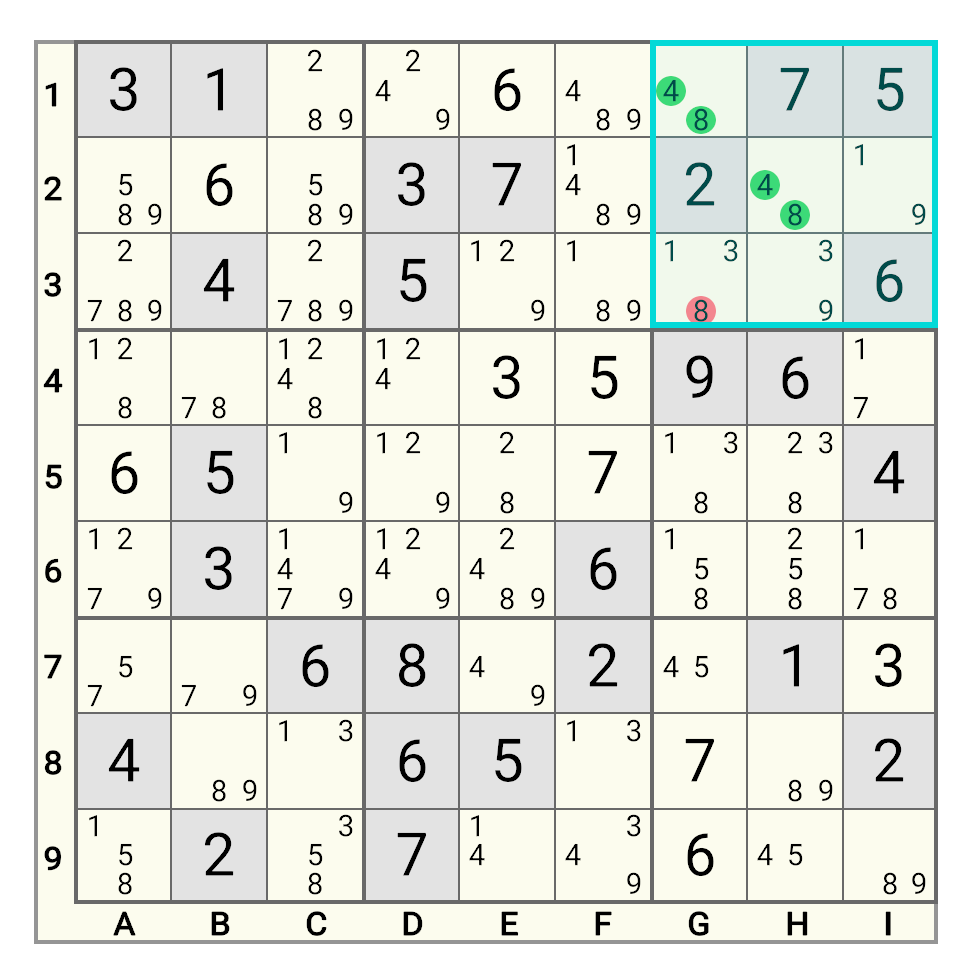
In the image, within Block 3 (blue region), cells G1 and H2 contain candidates 4 and 8 . Therefore, these 2 cells must be filled with these 2 numbers, so candidates 4 and 8 can be eliminated from all other cells in Block 3 .
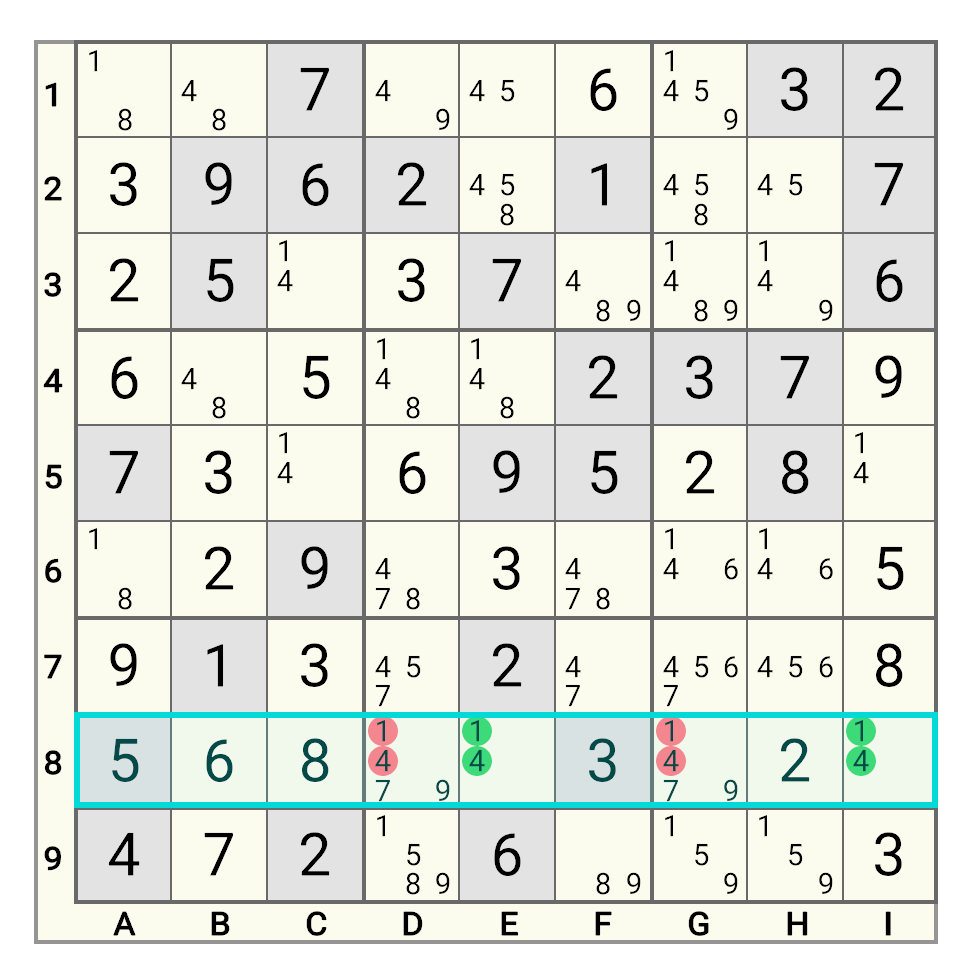
In the image, within Row 8 (blue region), cells E8 and I8 contain candidates 1 and 4 . Therefore, these 2 cells must be filled with these 2 numbers, so candidates 1 and 4 can be eliminated from all other cells in Row 8 .
Naked Triple
A Naked Triple is a Naked Set with . That is, 3 cells contain a total of 3 candidates.
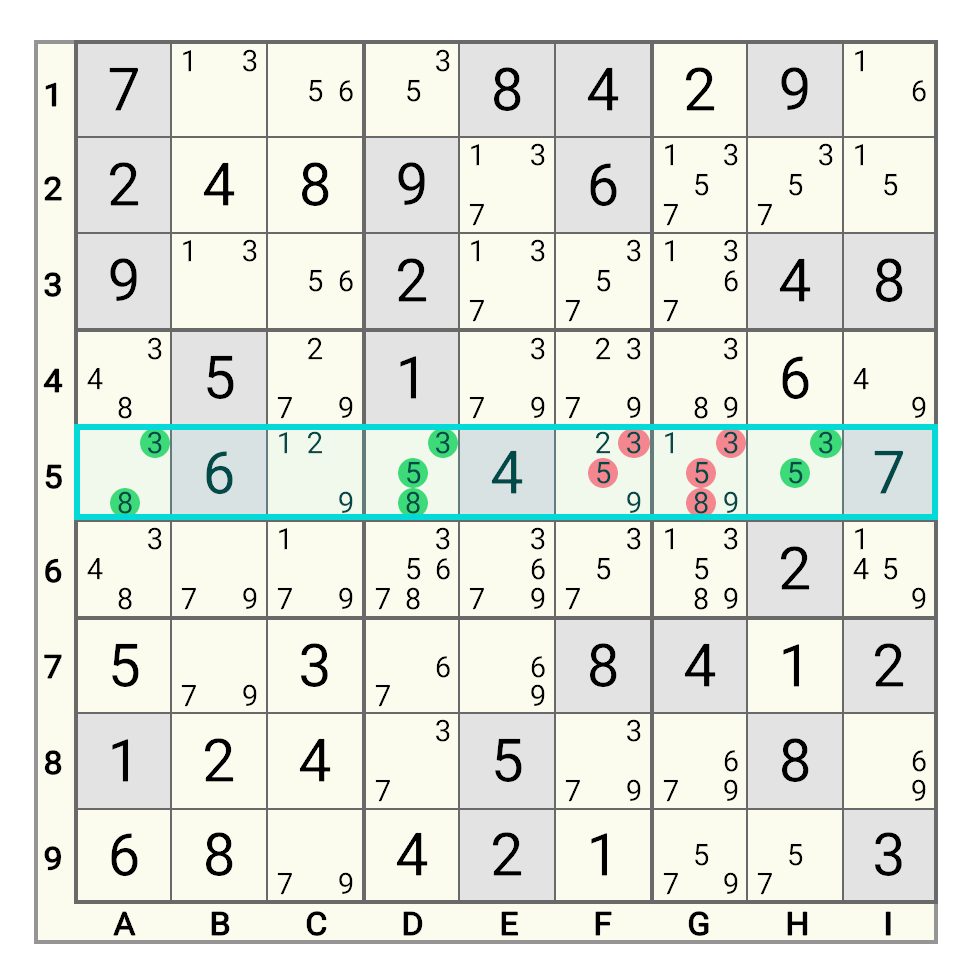
In the image, within Row 5 (blue region), cells A5 , D5 , and H5 contain candidates 3 , 5 , and 8 . Therefore, these 3 cells must be filled with these 3 numbers, so candidates 3 , 5 , and 8 can be eliminated from all other cells in Row 5 .
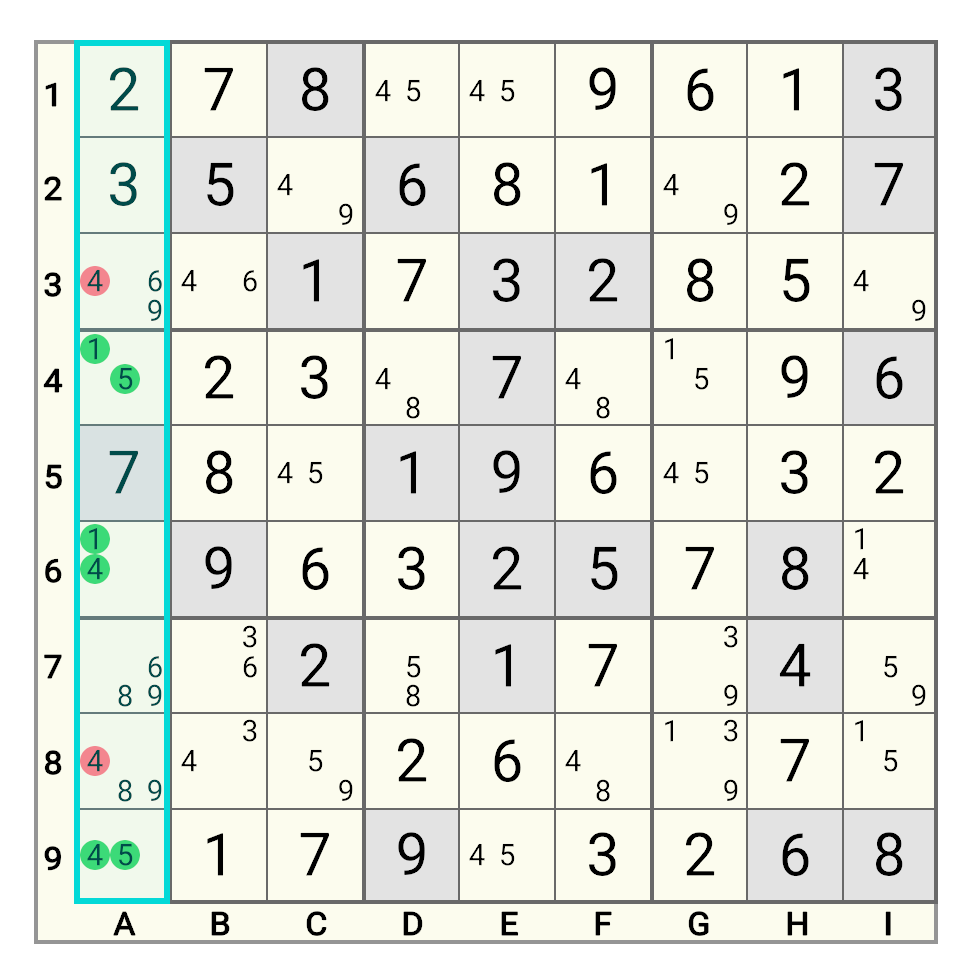
In the image, within Column A (blue region), cells A4 , A6 , and A9 contain candidates 1 , 4 , and 5 . Therefore, these 3 cells must be filled with these 3 numbers, so candidates 1 , 4 , and 5 can be eliminated from all other cells in Column A .
Naked Quadruple
A Naked Quadruple is a Naked Set with . That is, 4 cells contain a total of 4 candidates.
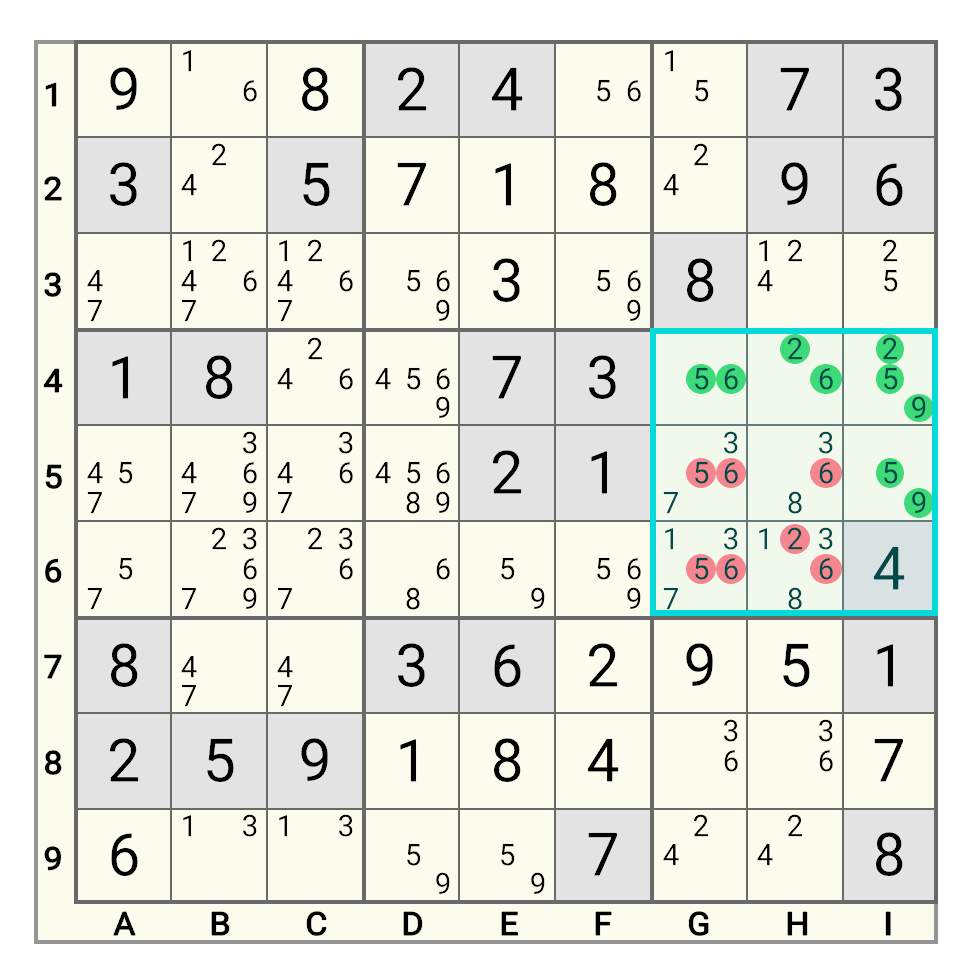
In the image, within Block 6 (blue region), cells G4 , H4 , I4 , and I5 contain candidates 2 , 5 , 6 , and 9 . Therefore, these 4 cells must be filled with these 4 numbers, so candidates 2 , 5 , 6 , and 9 can be eliminated from all other cells in Block 6 .
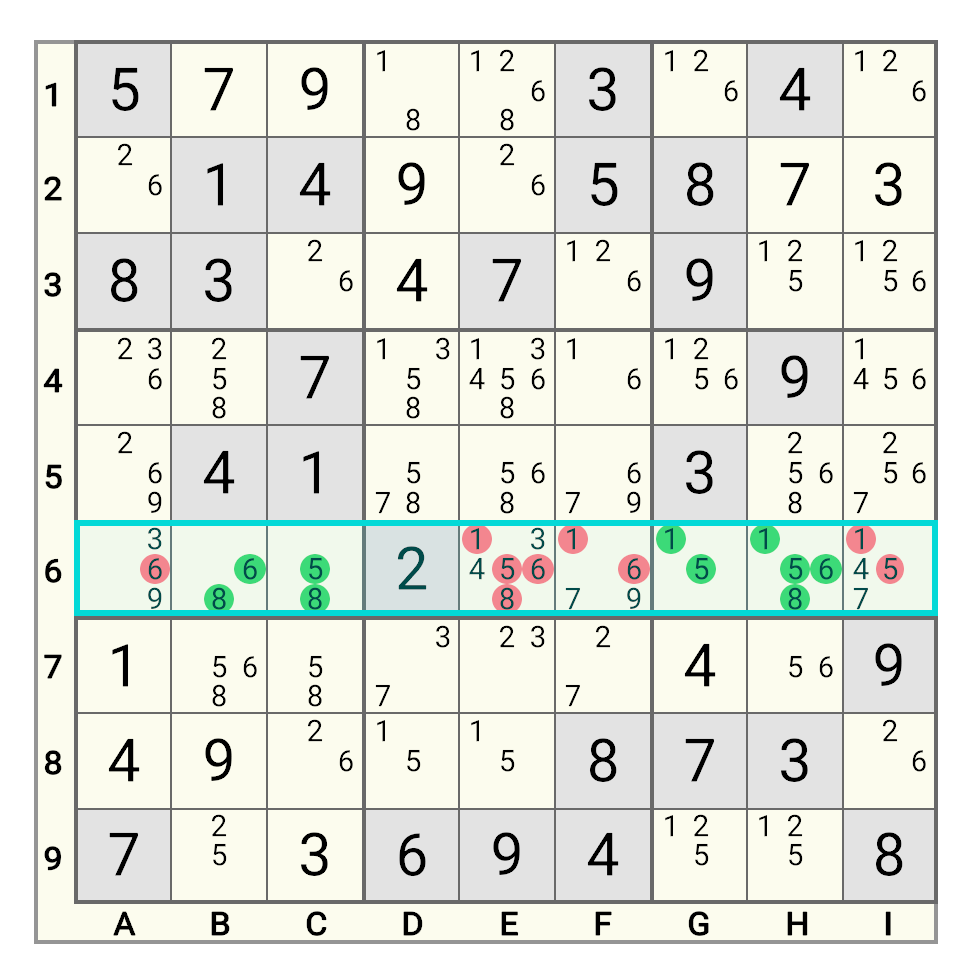
In the image, within Row 6 (blue region), cells B6 , C6 , G6 , and H6 contain candidates 1 , 5 , 6 , and 8 . Therefore, these 4 cells must be filled with these 4 numbers, so candidates 1 , 5 , 6 , and 8 can be eliminated from all other cells in Row 6 .
How to use :
- Find a group of cells (more than 1) that are in the same region (same row, column, or block)
- The total number of candidates in these cells equals the number of cells:
- Naked Pair : Find 2 cells in the same region with a total of 2 candidates
- Naked Triple : Find 3 cells in the same region with a total of 3 candidates
- Naked Quadruple : Find 4 cells in the same region with a total of 4 candidates
- Eliminate these candidates from all other cells in that region
Tips :
- Naked pairs are easiest to spot because the two cells typically have identical candidates
Naked Techniques Theory (Optional)
A Naked Set (the general case, including Naked Single) refers to a non-empty cell set in region with candidate set , where .
Proof of Naked Set Technique
Proposition : In region , if there exists a Naked Set with candidate set , then:
- Cells in must be filled with numbers from , with each number placed exactly once
- Candidates from can be eliminated from cells in
Proof :
According to Sudoku rules, cells in the same region cannot contain duplicate numbers, so the cells in must be filled with different numbers.
By the definition of candidate sets, cells in must be filled with numbers from , and since , cells in must be filled with all numbers from , with each number placed exactly once.
According to Sudoku rules, since cells in must be filled with all numbers from , therefore, cells in cannot be filled with numbers from . Therefore, candidates from in these cells can be eliminated.